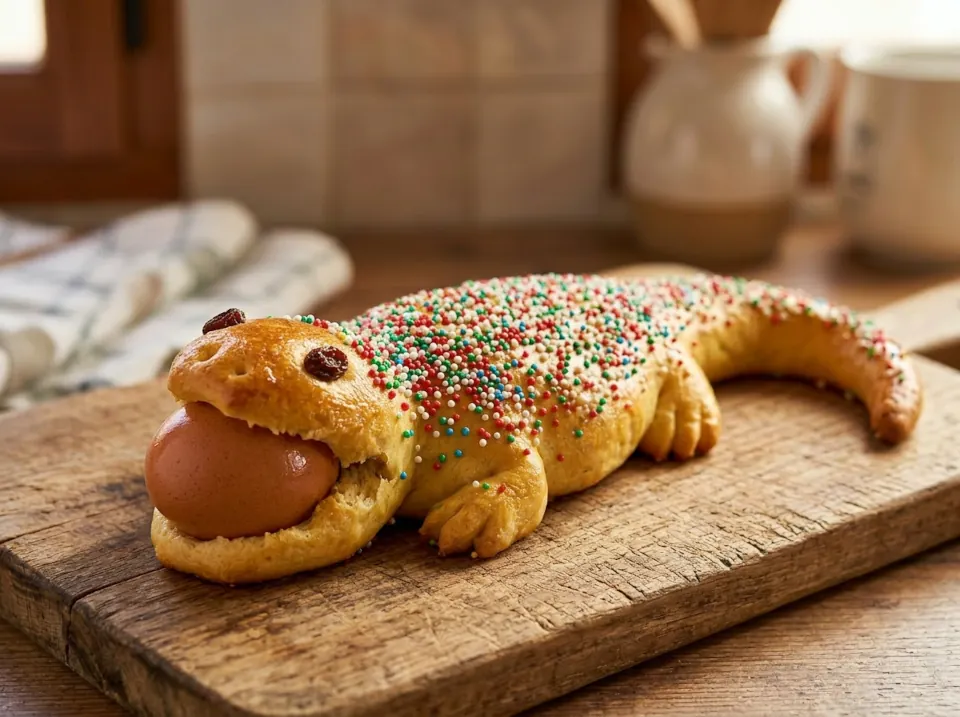
In the inland area of the province of Valencia, in towns such as Chulilla, Easter is not only celebrated with outdoor picnics, but also with one of the most unique expressions of Valencian popular culture: monas shaped like lizards or crocodiles, locally known as hardachos or fardachos. These figures, made with the same dough as other traditional sweets such as reguiño or the classic mona, represent an interesting intersection of gastronomy, symbolism, and language.
The Easter mona: a sweet with centuries of history
The Easter mona is a sweet found throughout the Mediterranean arc (from the Valencian Community to Murcia, Aragon, and Catalonia, all of which once belonged to the Crown of Aragon) and symbolizes the end of Lent. Traditionally, it is a brioche-like dough, flavored with citrus (orange in Valencia and lemon in Murcia) and decorated with eggs, a symbol of fertility and renewal.
However, far from being uniform, the mona takes on many shapes depending on the area: rings, braids, baskets… and also animals. In many Valencian towns, it is common to find monas shaped like snakes, turtles, or lizards.
The monas of Chulilla and their relationship with the reguiño
In Chulilla, the mona dough shares its base with other traditional sweets, such as the reguiño: a dough enriched with eggs, oil, sugar, and yeast, handmade and slowly fermented.
This shared dough reflects a cuisine rooted in resourcefulness and family tradition, where a single recipe serves different preparations depending on the celebration or the creativity of the moment. The difference lies not so much in the ingredients as in the shape, symbolism, and social use of the sweet.
The “hardacho”: the lizard-shaped mona
One of the most distinctive features of these monas is their lizard shape, known as hardacho (also spelled fardacho). This term refers to a lizard in linguistic varieties of the Valencian-Aragonese area.
These Easter mona figures shaped like lizards are not merely decorative. Going to the bakery and choosing this animal shape is part of a family ritual, especially for children, who pass the tradition down from generation to generation, ensuring that this cultural transmission is not lost.
Language and tradition: from Valencian to Aragonese
The term hardacho/fardacho is particularly interesting from a linguistic point of view. It comes from Romance variants of eastern Spain, where we find parallels between Valencian and Aragonese.
- In Valencian, fardatxo or fardacho refers to a lizard.
- In Aragonese, similar forms appear, such as fardacho or close variants.
This coincidence is not accidental. The Valencian Serranía, where Chulilla is located, has historically been a linguistic transition area between the Valencian domain and areas influenced by Aragonese. Medieval migrations and repopulation after the Reconquista left traces both in speech and in customs.
Thus, the hardacho is not just a dough figure: it is also a living linguistic vestige, a word that connects territories and traditions.
Towns where lizard-shaped monas are made
Although each locality has its own variations, the tradition of animal-shaped monas (especially lizards) continues in several parts of inland Valencia and nearby areas:
- Chulilla: a tradition deeply rooted in local culture, where children grow up eating these Easter monas and continue seeking them out as adults, hehe.
- Cortes de Pallás: famous for the “fardacho,” with an egg hidden in its head.
- Regions of La Serranía and inland Valencia (Chelva, Tuéjar, Andilla): where the mona takes on creative forms and is made within the family.
- Border areas with Aragon: where the tradition of the mona also exists and shares formal elements, such as animal figures.
In general, the further inland from the coast, the more common it is to find these zoomorphic shapes, which seem to preserve a more archaic and symbolic character.
A living tradition between play and memory
Monas shaped like hardacho perfectly capture the spirit of Mediterranean Easter: food, nature, and community. They are made at home or bought at the bakery, taken to the countryside, and shared in groups, in a festive context where games are even associated with them, such as cracking the egg on the head of someone distracted.
In Chulilla, it was very common to go either to the caves or to the Sote River to spend these moments with family. In the 21st century, with the rise of tourism, these kinds of traditions are mostly remembered by older generations. Still, you can always head down to Peña Judía to eat your mona or go to the bodegas to fly a kite.
These monas are an example of how popular culture brings together language, territory, and gastronomy in a single gesture. Each hand-shaped hardacho is not just a sweet: it is a small piece of history passed down from generation to generation.