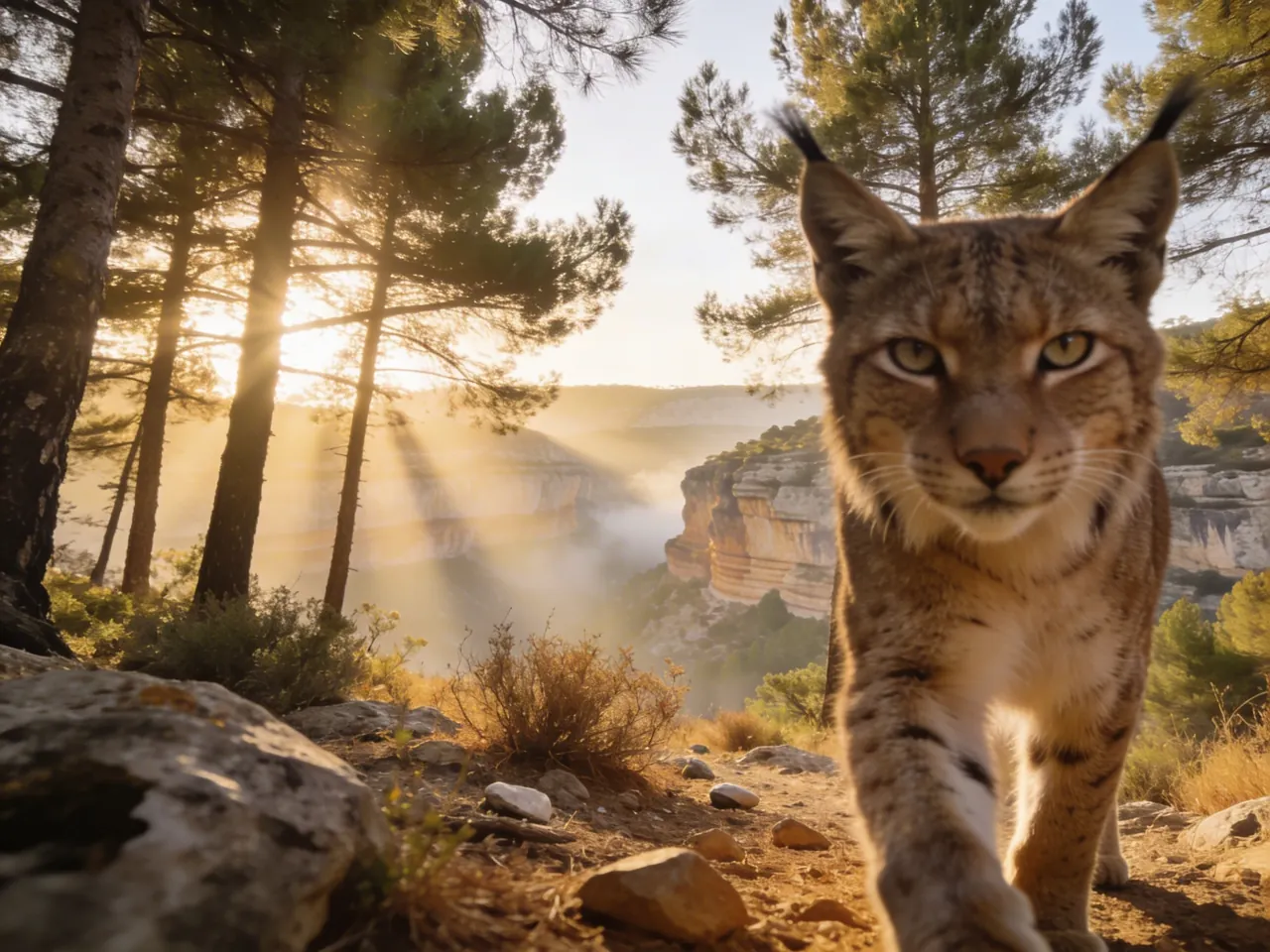
In May 2023, a lynx crossed Losa del Obispo. We have no further details. Whether it came from the west or the south…
The animal, according to testimonies gathered in the area, was seen moving with the caution that defines the species: elusive, light, attentive to every movement in its surroundings. It was not a settled specimen, but probably a young dispersing individual, one of those explorers that, driven by pressure from other populations or by the instinct to expand, travel long distances in search of territory.
And on that journey, La Serranía is no ordinary place.
From the perspective of someone who knows the Turia as it passes through Chulilla, it is almost natural to imagine the route. The river, wedged between rock walls and surrounded by pine forests, acts as a green artery that connects seemingly distant spaces. It is not a visible path for us, but it is for wildlife: a continuous corridor where the mountains link together, where silence endures, where it is still possible to move unseen.
Perhaps the lynx arrived from the south, following the slow recovery of the species in other areas of the Levant. Or perhaps it descended from inland, from territories in Castilla-La Mancha where populations have already become established. Its origin matters less than the fact that it found a way through. Because finding a passage means that the territory, despite everything, remains habitable.
And that is where the inevitable question arises: could it stay?
La Serranía has something that resonates with what the lynx needs. It is not just a matter of landscape, but of balance. There is Mediterranean scrubland, dense in some stretches, open in others, with natural shelters among ravines and hillsides. There are rabbits, though with fluctuations, sufficient in certain areas to sustain the passage of a demanding predator. And above all, there is a certain continuity, a sense of a territory not yet entirely fragmented.
But there are also limits. Roads that cut through invisible routes, changes in land use, human presence that, although scattered, alters the rhythm of the wild. The lynx that passed through Losa del Obispo knows this. That is why it moves on, why it does not stay. Not yet.
However, something is changing.
In recent years, the expansion of the Iberian lynx has ceased to be an exception and has become a trend. We are no longer talking only about the classic strongholds in the southwestern Iberian Peninsula, but about a species that is beginning to reconnect territories it had lost decades ago. And in this changing map, the Valencian Community once again appears as a possibility.
It is no coincidence that future reintroductions are being studied. Nor that ecological corridors are being analyzed. Nor that, from time to time, a lynx appears where previously only its memory remained.
From Chulilla, where the river draws meanders through rock and time seems to move more slowly, the news feels different. Not as an isolated event, but as a sign. One of those signs that does not impose itself, but invites us to look at the landscape with different eyes.
Perhaps the lynx crossed at dawn. Perhaps it followed the trail of a rabbit through the esparto grass. Perhaps it paused for a moment at the top of a hill, observing a territory that is not yet its own, but that could one day become so.
And then it moved on.
But the trace remains. Not on the ground, which the wind erases, but in the idea. In the possibility that this landscape, so often considered lost, still retains the capacity to host wild life in its purest form.
The lynx does not understand administrative borders or human plans. It only needs silence, food, and continuity. If those exist, it returns.
And in places like Losa del Obispo, like Chulilla, like so many corners of La Serranía, perhaps it never fully left. It was only waiting for the right moment to reveal itself again.